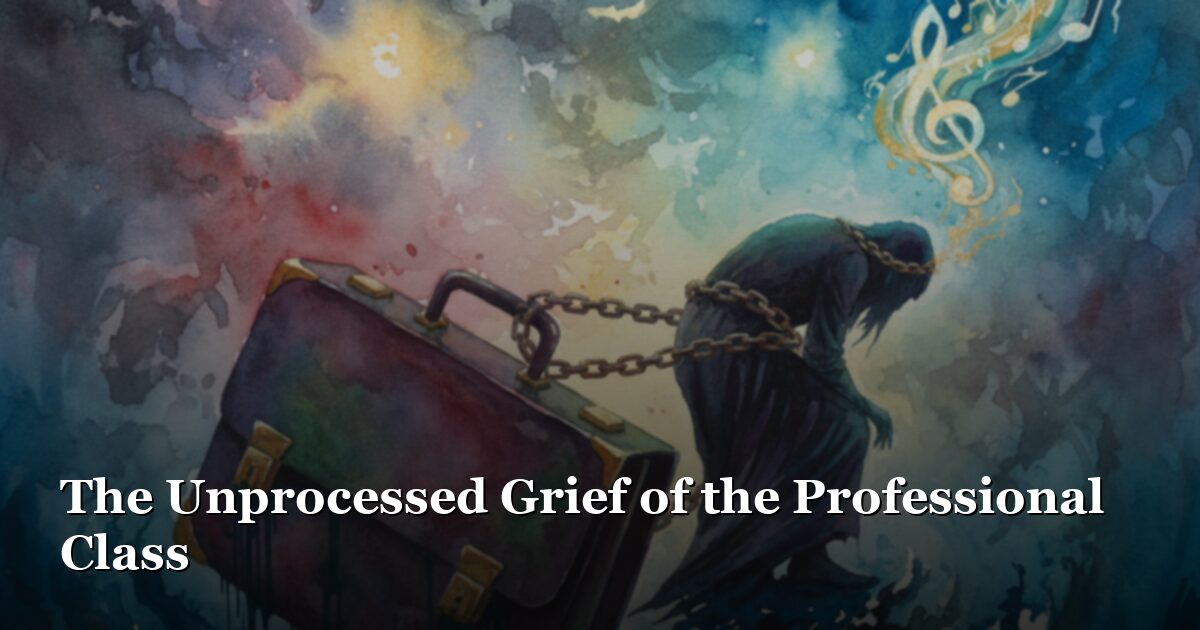
You haven’t lost someone to death recently (maybe you have, and if so, this still applies). But there’s a heaviness you carry that doesn’t have an obvious source. It sits in your chest, makes certain songs unbearable, shows up as a flat, gray exhaustion that sleep doesn’t fix. You’re carrying grief, and you might not even know it. Grief isn’t reserved for funerals. In the professional world, grief accumulates from sources nobody teaches you to mourn.
The grief nobody talks about
Mid-career is full of losses that don’t come with condolence cards:
- The role you outgrew. You were great at it, you loved parts of it. The promotion was the right move, but you never acknowledged that something died when you moved on.
- The team that got reorganized. You built something together, and then a restructuring scattered everyone. You moved on to the new org chart without processing the loss of something that mattered.
These losses are real, and they compound. Each one deposits a thin layer of heaviness that, over years, becomes the background weight of your professional life.
Why professionals don’t grieve
Professional culture has no space for this kind of grief. There’s no bereavement leave for the career you didn’t pursue. Nobody sends flowers when your favorite team gets disbanded. You’re expected to be “excited about the new opportunity” even when the old one mattered to you. So you do what professionals do: you package the loss as growth, you focus on what’s ahead, and you keep moving. The grief doesn’t go anywhere. It just goes underground. In the framework, this is Air dimension territory: the heart center, where connection and grief live. When grief goes unprocessed, the heart center closes. Not dramatically (you don’t stop loving people), but subtly. You become slightly less available, slightly more guarded. And because it happens gradually, you don’t notice until someone points out that you seem different than you used to.
How unprocessed grief shows up at work
Grief doesn’t announce itself. It disguises itself as other things:
- Cynicism. “I’ve seen this before. It won’t work.” Sometimes that’s experience talking. Sometimes it’s grief talking, protecting you from investing in something that might be lost.
- Disengagement. The projects that used to excite you feel flat, not because the work changed, but because your capacity to care is being consumed by unacknowledged loss.
If you’ve noticed that your enthusiasm for work has faded gradually over years (not because of a specific event, but as a general drift), unprocessed grief is worth considering.
Music and the grieving process
Grief needs expression to move. When you can’t talk about it (because there’s no socially acceptable venue for mourning your former team), music becomes the outlet. The framework uses Air dimension work to create a safe container for grief. Here’s the practice: Allow the song to find you. Don’t curate. Let your instinct choose. The song you’ve been avoiding because it makes you emotional? That’s probably the one. The music your body flinches away from is often the music that holds the grief you need to process. Listen without agenda. Don’t try to feel better; don’t try to “get through it.” The goal is contact: making contact with the loss, acknowledging it, and letting it exist without rushing to resolve it. After the song, sit in the silence for a minute. Notice what’s in your chest. Name the loss if you can. If you can’t name it, that’s fine too. The practice is presence, not analysis.
Grief proves something mattered
When you start processing grief, you discover something: underneath it is love. You grieve the team because you loved being part of it. You grieve the career path because you loved who you might have become. Grief is proof that something mattered. When you process grief instead of suppressing it, you don’t become sadder. You become more available. The emotional energy that was locked up in holding back loss gets freed up for present-tense connection. Your capacity for engagement at work increases because you’re no longer spending resources keeping grief underground. Grief shows up in the Reset Score as the Love dimension. See where yours stands. The Air dimension measures your capacity for connection and grief. If this post resonated, your Air score might reveal a pattern you’ve been feeling but haven’t had language for. The full Reset Score covers all seven dimensions, 21 questions in about three minutes.