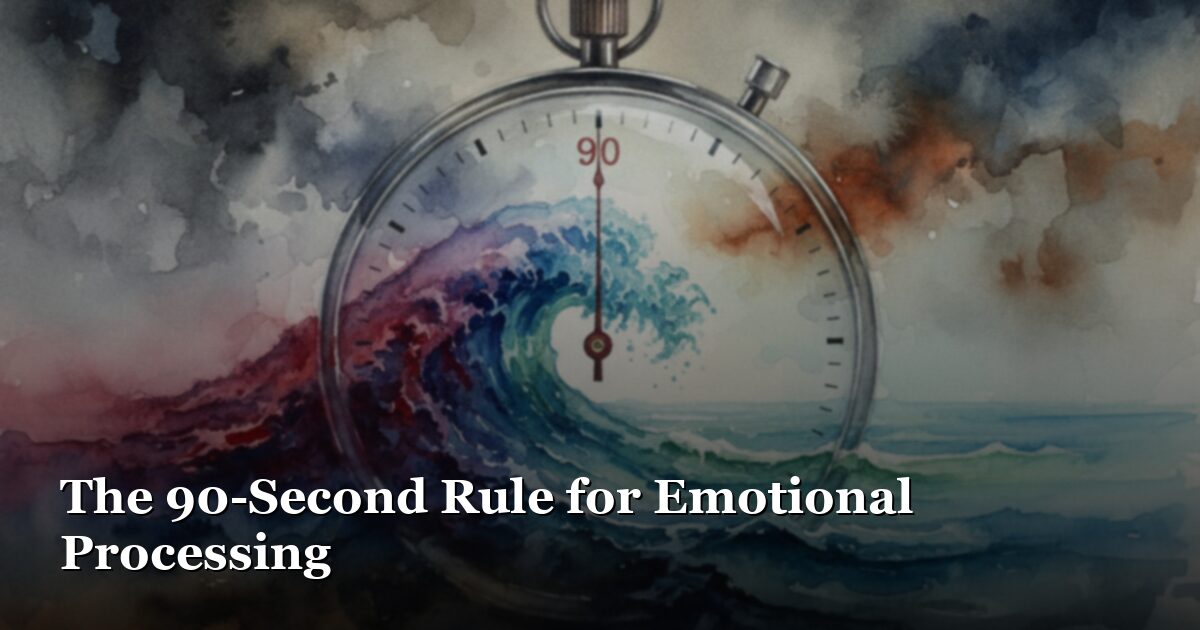
Dr. Jill Bolte Taylor’s research gives us a useful number: 90 seconds. That’s how long the chemical signature of an emotion lasts in the body. After 90 seconds, the feeling is being sustained by your thinking, not your biology.
This doesn’t mean emotions are over in 90 seconds. It means the raw neurochemical wave is. Everything after that point is a thought loop replaying the trigger, and thought loops are something you can interrupt.
The practice
When a strong emotion hits (anger after a meeting, grief that surfaces unexpectedly, anxiety before a presentation), do this:
- Notice the feeling in your body. Where is it? Chest, stomach, throat, jaw?
- Set a mental timer. You’re giving this feeling 90 seconds of your full, undivided attention.
- Don’t narrate. Don’t explain it to yourself. Don’t assign blame or start problem-solving. Just feel the physical sensation.
- Breathe. Not special breathing, just conscious breathing.
- After 90 seconds, check in. The intensity will have changed. Not disappeared, but shifted.
Why music makes this easier
Most people find 90 seconds of unstructured emotional space uncomfortable. Music solves that by providing structure. Put on a song. The song is your container. You know exactly when it ends. You’re not committing to an open-ended emotional experience; you’re committing to one track.
The Water Practice uses this principle as its foundation. A three-to-four-minute song gives you two full 90-second cycles with a natural beginning, middle, and end. The music holds the space so you don’t have to.
What happens with practice
After a few weeks of using the 90-second rule, most people report two shifts. First, emotions feel less threatening because you’ve proven to yourself they’re finite. Second, you start catching emotions earlier (before they escalate into reactions) because you’ve trained your awareness to notice the body signals.