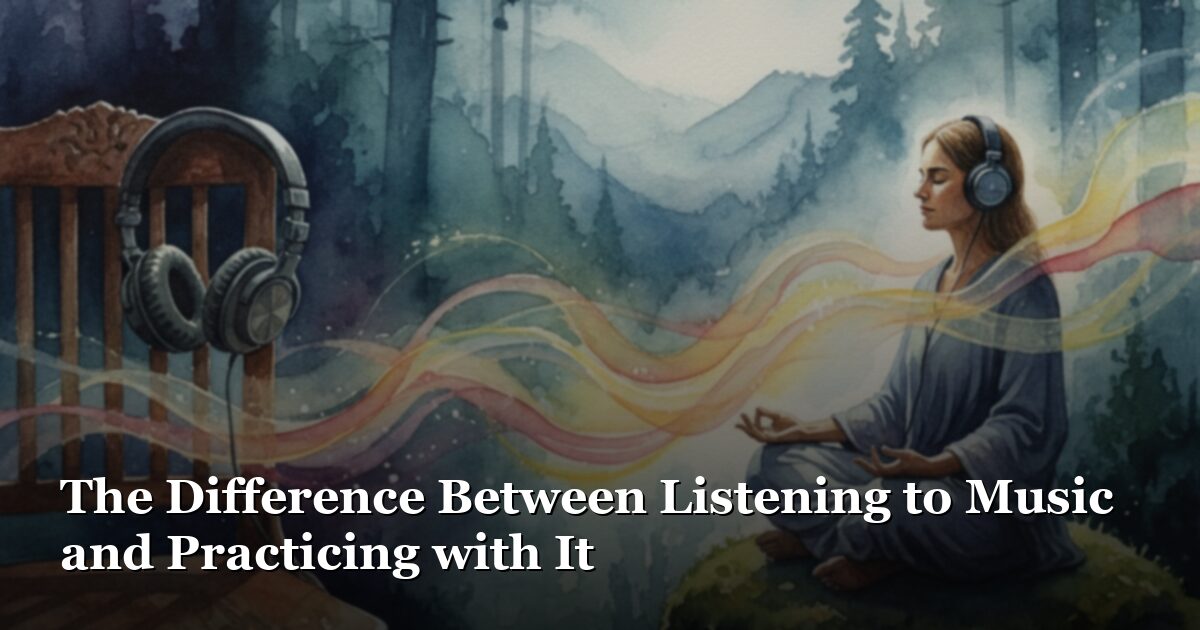
You already listen to music every day. In the car, at the gym, on the walk between meetings. Music is the most consumed art form on the planet, and almost nobody uses it on purpose. That gap between listening and practicing is where Music & Meditation lives.
Practicing Means Choosing the Feeling
There’s nothing wrong with throwing on a playlist and letting it ride. Music improves mood, lowers stress hormones, and makes a commute bearable. But passive listening is like stretching before a workout: helpful, not transformative. When you practice with music, you’re choosing a song for a specific emotional reason, sitting with it deliberately, and letting it do targeted work on a part of your life that needs attention. Think about the difference between scrolling through your phone and writing in a journal. Both involve words. One is consumption; the other is processing. Music works the same way. A song can wash over you, or it can become the vehicle for confronting a feeling you’ve been carrying around since Tuesday.
What “Practice” Actually Looks Like
Practicing with music isn’t complicated, but it does require two things most people skip: intention and attention. Intention means knowing why you’re pressing play. Are you trying to ground yourself after a chaotic morning? Process frustration from a conversation that went sideways? Reconnect with a sense of personal power you’ve been handing away in meetings all week? Each of those maps to a different level in the framework, and each calls for different music. Attention means staying present while the song plays. No multitasking, no checking Slack. Sitting with headphones on, eyes closed if you can, and letting the music pull the feeling to the surface where you can actually work with it. Pick the level and pick the song; press play and pay attention. Five minutes of deliberate musical practice does more for your nervous system than an hour of background listening.
Why Most People Never Make the Shift
Because nobody taught us to. We learned music as entertainment, as background, as identity (your taste, your era). We never learned music as a tool for emotional processing and personal reset. The framework we teach gives that shift a structure: seven levels, each tied to a specific emotional pattern and its own sonic signature. You’re not guessing which playlist might help. You’re diagnosing what needs attention and choosing music that meets you there. The shift from listening to practicing is small in effort and enormous in impact. You need a song and a reason. — Practicing with music starts with knowing what you’re practicing for. The Reset Score gives you that clarity. It maps where you stand across all seven levels of the framework, takes about three minutes, and shows you exactly which level is calling for attention first.