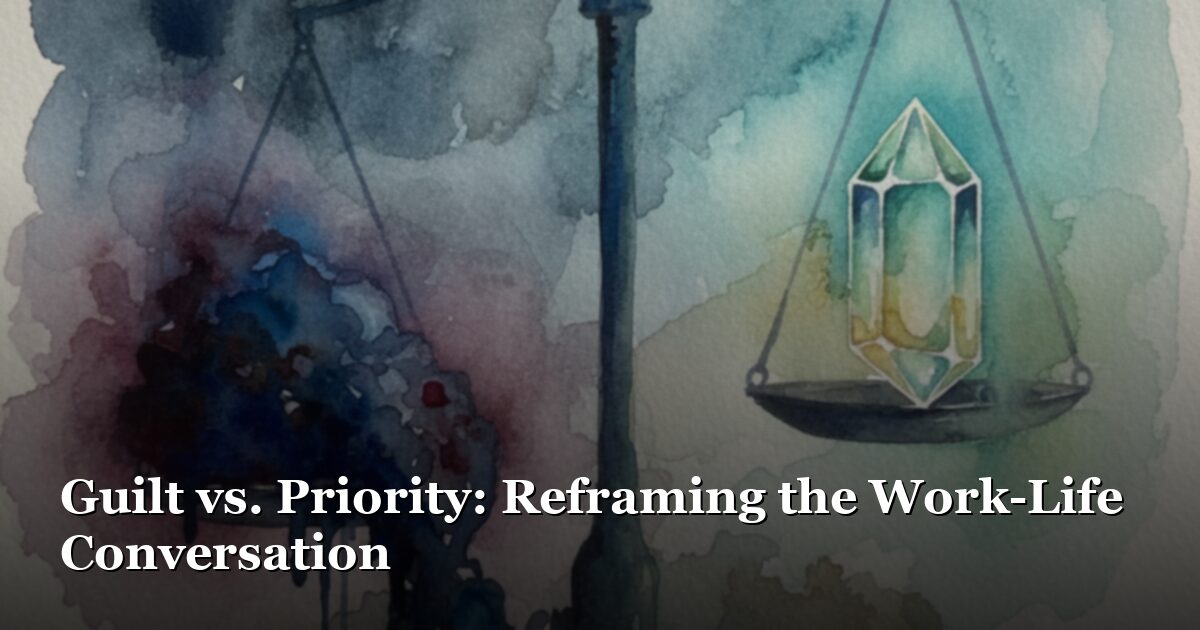
You said yes to the committee, the extra project, the weekend event, and the mentoring relationship. You said yes because it felt important. But was it actually important, or did saying no feel too uncomfortable? If you’ve been overcommitted for the last few years, chances are you’re overcommitted to guilt, not priorities. You can’t tell the difference because both feel urgent, both carry consequences, and both arrive wearing the same costume: “I should.” The Water dimension (Level 2) connects to guilt as the shadow emotion. Guilt is the emotional residue that clouds your ability to see what actually matters versus what you’ve agreed to carry because putting it down feels worse than holding it.
How Guilt Disguises Itself
Genuine priorities align with your values and the life you’re actively building. Guilt-driven commitments align with someone else’s expectations and your fear of what happens if you don’t meet them. The tricky part: both generate a sense of obligation. Both feel like they matter. The difference shows up in how you feel after giving your time to each one.
- After spending time on a genuine priority, you feel tired but aligned. The work cost energy and returned meaning.
- After spending time on a guilt-driven commitment, you feel resentful and drained. The work cost energy and returned relief (“at least that’s done”) but not satisfaction.
That resentment signal is reliable. If you consistently feel resentful after completing a commitment, you’re servicing guilt, not a priority.
The Guilt Inventory
Pull out your calendar from the past two weeks. Look at every commitment that wasn’t strictly required by your job description or your core family responsibilities. For each one, ask two questions:
- If nobody knew I skipped this, would I still go? This strips away the social consequence and reveals whether the commitment has intrinsic value to you.
- If I’d said no six months ago, would my life be worse today? This tests whether the commitment is building something or maintaining an obligation.
Anything that gets a “no” to both questions is a guilt commitment. You’re doing it because stopping feels like a character flaw.
Why This Is an Emotional Problem
Guilt lives in the body, not the mind. You can logically understand that a commitment isn’t serving you and still feel physically incapable of letting it go. Your stomach knots. Your chest tightens. The thought of saying “I can’t do this anymore” triggers a stress response that feels identical to actual danger. That’s because, for most of us, guilt was one of the earliest emotional tools used to shape our behavior. Long before anyone explained priorities or values, guilt taught us what was expected. It runs deep, and rational analysis alone won’t override it. This is where the emotional processing tools of Level 2 become practical. You can’t think your way out of guilt. You have to feel your way through it, which means actually letting the emotion surface and move instead of suppressing it under another “yes.”
A Practice for Sorting Guilt from Priority
When you’re facing a commitment decision and you’re not sure which one is driving it, try this:
- Sit with the “no” for two minutes. Don’t say it yet. Just imagine saying it. Notice what happens in your body. Where does the tension show up? What story does your mind tell? (“They’ll think I’m selfish.” “I’ll be letting them down.”)
- Put on a song that gives you permission to feel. Something from your emotional processing playlist, or any song that opens you up rather than numbing you. Let the music hold the guilt while you observe it. After the song, ask the values question: does this commitment serve a value I’ve chosen, or an expectation I’ve inherited?
The music step matters because it interrupts the guilt spiral. Without it, most people loop between “I should say no” and “but I can’t” indefinitely. The song creates a pause where the emotion can be felt without being acted on, and in that pause, clarity usually shows up.
Protecting Your Priorities
Once you’ve identified your guilt commitments, you don’t have to quit them all at once. Start with one. The easiest one. Say no or step back. Notice what happens. In nearly every case, the consequence you feared (rejection, judgment, damaged relationships) is either smaller than you imagined or doesn’t arrive at all. Each guilt commitment you release frees energy for something that actually matters. Protecting your priorities requires making guilt familiar enough to tolerate, and the practice builds that tolerance over time. Guilt and priority conflict look the same from the inside. The Reset Score helps you tell the difference. Take yours at musicandmeditation.com.