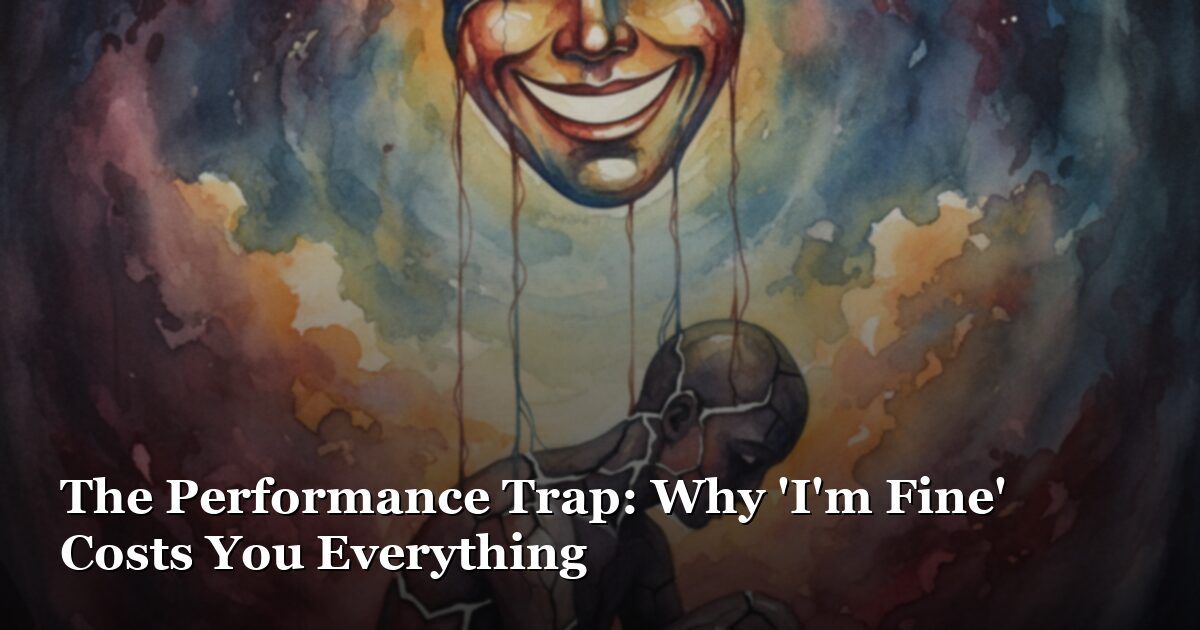
“I’m fine” is the most expensive sentence in your vocabulary. You’ve said it thousands of times: to your partner, your team, your boss, yourself. Almost every time, it was a lie. Not a malicious one. A reflexive one. “I’m fine” is a performance, and you’ve been running it so long you’ve forgotten it’s not real. If your Reset Score on the Sound dimension is low, this post is going to feel uncomfortably familiar.
How the Performance Installs Itself
Nobody decides to become inauthentic. It happens in layers. You learn in your twenties that certain emotions aren’t welcome at work. You learn that “I’m struggling” gets you sidelined, that the people who get promoted are the ones who look like they have it together. So you start performing “together.” You perform it so consistently that your body starts believing it, even when your sleep is wrecked and your patience is gone.
The Energy Cost of Performing “Fine”
Performing “fine” is one of the most expensive things you do every day. Maintaining a false front requires constant monitoring: watching your tone, editing your responses before they leave your mouth. That monitoring runs in the background all day. It’s why you collapse on the couch at 7 p.m. even when your workload was manageable. The work wasn’t what drained you. The performance was. Research on emotional labor confirms this. People in roles that require sustained emotional performance (suppressing real feelings, displaying feelings they don’t have) show higher rates of burnout and measurable cognitive fatigue. You might not be a flight attendant, but if you’re performing “fine” in every meeting, you’re doing the same thing.
What Inauthenticity Actually Costs
The energy drain is only the surface. The deeper cost is disconnection. When you perform “fine” long enough, you lose access to your own internal signals. You stop knowing when you’re overwhelmed until you’re already in crisis. Your relationships flatten because nobody is interacting with the real you; they’re interacting with the character you’ve built. The Sound dimension sits at the bridge between what you feel internally and what you express externally. When that bridge is blocked, everything above and below it suffers. Your clarity gets clouded because you can’t think straight when you’re suppressing. Your sense of purpose fades because purpose requires honesty about who you actually are.
The “I’m Fine” Audit
Try this for one week. Every time you say “I’m fine” (or any variant: “good,” “can’t complain,” “hanging in there”), pause and ask yourself what the real answer is. You don’t have to share it. Just notice the gap between performance and reality. Most people find that gap is wider than they expected. The audit isn’t about shaming yourself for performing. It’s about seeing the pattern clearly enough to start choosing differently. You can’t change a reflex you haven’t noticed.
Where Music Comes In
Music is useful here because the songs you love are often more honest than you are. You’ll listen to a song about exhaustion or loneliness and feel something loosen in your chest, because the artist is expressing what you won’t let yourself say. That loosening is your body recognizing truth. Start paying attention to which songs make you feel seen. Those songs are mirrors, and they’re reflecting back the version of you that “I’m fine” keeps hidden. The wall you built to protect your performance is the thing degrading it. The Reset Score measures what “I’m fine” hides.